
SAP’s Cloud Journey: Private to Public Cloud – What July’s Announcement Means for You

SAP ERP Public and Private Cloud Vortex Consulting Support

At Vortex Consulting, we’ve been helping clients navigate the complexities of SAP transformation for decades. This past July, SAP reinforced its innovative vision for the future of ERP by further clarifying the journey between private cloud and public cloud options. This evolution is about giving SAP customers the flexibility to choose a path that matches their pace, industry requirements, and IT growth ambitions.

The Big Cloud Picture

SAP repositioned its cloud ERP strategy to better reflect the journey its clients take as they move to the cloud. What was once known as RISE with SAP is now presented as the SAP Cloud ERP Private Edition—an evolution that emphasizes flexibility, investment protection, and a structured journey for complex enterprises. At the same time, GROW with SAP continues to anchor the Public Edition journey, offering a fit-to-standard SaaS model for organizations seeking speed and simplicity. Together, these two paths highlight SAP’s commitment to meeting clients where they are—whether preserving the value of existing systems or embracing a clean, future-ready cloud foundation.

What’s the Difference Between Public and Private Cloud Journeys?

SAP Cloud ERP Private Edition (formerly RISE with SAP)

RISE with SAP Private Cloud officially known as SAP S/4HANA Cloud, Private Edition is a cloud-based ERP journey designed to help organizations smoothly transition existing on-premises SAP ERP or SAP S/4HANA environments into a fully managed, single-tenant cloud setup. Every organization’s journey to the cloud looks different—but RISE with SAP makes it easier to get there. As a subscription-based service, it blends structure with flexibility: offering ready-to-use solutions while adapting to your company’s unique needs. Scalable and efficient, it can be implemented quickly and evolves as your business grows, making cloud-based digital transformation more accessible than ever.

As offered by Vortex Consulting, this solution combines the structure of a subscription-based service with high flexibility and customization—enabling fast deployment, real-time insights, and integration across automation, cybersecurity, analytics, and other essential capabilities.

SAP S/4HANA Cloud, Private Edition is more than just ERP stand along solution, it delivers a modular, secure ERP infrastructure hosted via hyperscaler partnerships with SAP managing core cloud operations, SLAs, and technical support, while clients maintain control over customization and scaling.

RISE with SAP (now Cloud ERP Private Edition) offers:

  • A comprehensive transition path that modernizes on-premises ERP systems via a cloud operating model built on a proven methodology.
  • Investment protection, enabling organizations to preserve legacy systems while embracing innovation.  

Learn more at: http://vortexconsulting.net/sap-solutions/rise-with-sap/

Private Cloud: Control and Flexibility

For large enterprises with complex operations, strict regulatory obligations, or extensive customizations, SAP S/4HANA Cloud, Private Edition delivers the control and flexibility some SAP customers require while still providing the advantages of a managed cloud environment. Unlike a standardized public cloud model, the private edition allows organizations to preserve their unique processes and tailor the system to fit their business without sacrificing security or compliance.

Key Benefits Include:

  • Tailored system configurations and custom code compatibility: Companies can migrate existing SAP environments—including legacy custom code—without starting from scratch, ensuring continuity of mission-critical functions.
  • Greater flexibility in defining business processes: Enterprises have the freedom to design, adjust, and evolve workflows at their own pace, aligning with industry-specific requirements and long-term transformation goals.
  • Enterprise-grade security and governance: The solution provides advanced data protection, compliance management, and governance tools to meet global regulatory standards, making it ideal for organizations operating in highly regulated industries.

SAP’s July update introduced new transition options to make the private cloud journey smoother, ensuring customers can modernize at their own pace while preparing for the future beyond 2030.

SAP Cloud ERP Public Edition (GROW with SAP)

GROW with SAP Public Edition officially known as SAP S/4HANA Cloud, Public Edition is a standardized SaaS ERP solution, ideal for organizations seeking rapid, fit-to-standard deployments with future scalability. SAP Cloud ERP Public Edition, branded as GROW with SAP, is a modern, ready-to-run cloud ERP offering built on the SAP S/4HANA Cloud platform. Tailored for mid-market and rapidly expanding businesses, it delivers preconfigured, industry-aligned best practices, embedded AI and analytics, and continuous quarterly innovation—all without the complexity traditionally associated with ERP implementations. This solution empowers organizations to scale operations, launch new business lines, and modernize outdated systems, while maintaining enterprise-grade security, compliance, and cost predictability through a subscription-based model

Vortex Consulting enhances the GROW experience through a deep partnership with SAP, offering personalized, hands-on support that leverages exclusive resources, training, and roadmap alignment. Their services span the full spectrum—from cloud-readiness assessments and rapid deployment (via SAP Activate) to legacy data migration, analytics enablement, change management, and post-go-live optimization. Backed by nearly three decades of SAP expertise as a Silver Partner, Vortex deploys seasoned consultants who help mid-sized organizations adopt cloud ERP smoothly and strategically.

Public Cloud: Agility and Innovation

For organizations that prioritize rapid deployment and standardized best practices, the SAP S/4HANA Cloud, Public Edition provides a streamlined and cost-effective alternative to traditional ERP implementations. Designed as a ready-to-run solution, it allows businesses to adopt modern ERP capabilities quickly without the need for heavy customization. This makes it especially valuable for growing companies that want to accelerate digital transformation while staying agile and cost-efficient.

Key Benefits Include:

  • Preconfigured industry best practices: Built-in, proven process templates reduce implementation time and ensure alignment with industry standards.
  • Regular quarterly updates: Continuous innovation is delivered seamlessly, keeping systems current with the latest functionality, compliance, and security improvements.
  • Lower total cost of ownership with faster ROI: Subscription pricing and reduced infrastructure costs allow businesses to see value quickly while minimizing financial risk.
  • Embedded AI, analytics, and automation tools from day one: Intelligent features drive smarter decision-making, streamlined workflows, and operational efficiency.

At Vortex Consulting, we’ve seen mid-market companies in particular thrive with the Public Edition. For these organizations, scalability and speed are critical for growth, and the public cloud model provides both—helping them modernize processes, adapt to market changes, and unlock innovation at a pace that supports long-term success.

Learn more at: http://vortexconsulting.net/sap-solutions/sap-cloud-erp-public-edition/

Why This Matters Now

SAP’s July announcements highlight one truth: there is no “one-size-fits-all” cloud journey. Some organizations will move directly to the public cloud to capture innovation quickly, while others will need the flexibility of the private edition to protect critical custom processes.

The good news is that SAP is providing structured, supported pathways for both. Whether it’s leveraging the transition option for private cloud or accelerating growth with public cloud, businesses can move forward with confidence.

How Vortex Consulting Can Help

Choosing the right path is a strategic decision—one that requires balancing business needs, IT landscapes, and long-term goals.

At Vortex, we help SAP clients:

  • Assess their current SAP environments and readiness for cloud migration
  • Define the right cloud strategy (private, public, or hybrid)
  • Implement and optimize either your SAP ERP Public or Private solutions
  • Support ongoing innovation and adoption with minimal disruption
  • Prepare for their transformation with our OnRamp Methodology

SAP’s recent announcement underscores the flexibility organizations have in their cloud journey. With the 2030 deadline is on the horizon for legacy ERP support, companies that start evaluating their options now will be best positioned to make smooth transitions, avoid disruption, and fully realize the value of cloud ERP. Whether you’re ready for the agility of Public Cloud or require the stability of Private Cloud, the future of SAP ERP is about choice—and Vortex Consulting is here to guide you every step of the way. Contact us today to get started with a free consultation with a SAP solution architect.


SAP for Utilities Conference Presented by ASUG

September 8-10, 2025

Colorado Convention Center

The Vortex Consulting Team is excited to be on-site at SAP for Utilities 2025, the premier North American gathering for utility ERP professionals, taking place September 8–10 at the Colorado Convention Center in Denver. We’ll be engaging with cutting-edge sessions on SAP-driven transformation—from Cloud strategies and asset management to AI-powered analytics—helping SAP clients turn complexity into competitive advantage. To learn more about the conference click here – see you there!

SAP S/4HANA Ground Zero Starts Before Phase Zero – Where Transformation Begins

Blog SAP S/4HANA Ground Zero Starts Before Phase Zero – Where Transformation Begins

Motivations for SAP upgrades range from cost, compliance, and revenue growth to financial performance, among others. However, nearly all these drivers face hidden barriers. In discussions with customers about data quality and archiving, two recurring themes often emerge and are highly relevant to SAP S/4HANA transformations:

• Misaligned data retention and destruction practices
• Limited exposure to enterprise-wide information governance principles within the business

Defining your Ground Zero, where your foundation is solid and where it needs reinforcement, begins with one simple, strategic question:

“How do we handle data retention and destruction?”

The answer to this question reveals more than just policy gaps; it shows how much control you have over cost, timeline, agility, and ultimately, transformation success.

Information Governance is Ground Zero, before Phase Zero even starts.

It’s where you start:

  • Controlling project scope and cost.
  • Reducing long-term IT operating costs.
  • Enabling agility to shift with markets and tech.
  • Creating a foundation for trustworthy, transparent data.

From Patchwork to Purpose

My first encounter with SAP archiving was 25 years ago. Imagine this: 18 months into a multi-plant rollout, it stalls at “Live” sites due to data volume issues in revenue-critical processes. We fixed it with archiving, but it was a patchwork solution.

Even today, archiving is still often viewed as a technical cleanup, disconnected from broader governance and transformation strategies. That perspective limits its value. The great news in the Ground Zero perspective is that you have a clean slate to innovate governance that can scale with your company’s ever-evolving requirements.

A future post will cover the essentials of Phase Zero. For now, let’s stay focused on the bigger picture.

Why ILG?  Why Now?

Information Lifecycle Governance (ILG) is the management of data from creation to destruction.  Wrapped around that lifecycle are the Three P’s:

  • Policy – Is it modern, enforceable, and relevant?
  • People – What is the RACI for ILG?
  • Processes – Are they scalable, cost-effective, and structured to service your business?

Many organizations still depend on data retention policies designed for paper records or legacy systems.  That’s like trying to increase revenue with a CRM that holds both current and obsolete contacts and preferences—it slows down progress, obscures insights, and risks eroding trust.  Why would out-of-date policies still meet today’s goals for growth, compliance, or customer experience?

A VP and a CFO from two separate companies recently discussed similar objectives for their ILG efforts.

  • Accountability for governance
  • Ownership roles that drive clarity
  • Best practices that minimize silos and promote transparency
  • Reducing data footprints ahead of upgrades or cloud migrations

Sound familiar?

Before You Plan Your SAP S/4HANA Transformation

What could your transformation look like with early visibility into quiet barriers—and a clear path to address them before Phase Zero begins?

Positioning Information Lifecycle Governance (ILG) as Ground Zero sets a foundation for buildable value. It identifies the same decisions, innovations, and ownership models that your S/4 transformation will rely on.

By addressing these barriers early, Phase Zero gains meaningful traction, with a clean core strategy, stronger accountability, and alignment across the business.

Let’s start the conversation…

That’s how transformation builds lasting momentum. And that’s where we bring focus, structure, and value. If you’re ready to explore where your ILG stands today, we’re here to help. Learn more about Vortex Consulting’s SAP Data Volume and Archiving services, or contact us to get started today! 

Unlock SAP S/4HANA Success: Attend Vortex Consulting’s Readiness Workshop on August 14

Vortex Consulting's SAP S/4HANA Readiness WorkshopThe move to SAP S/4HANA is more than just an upgrade project—it’s a strategic transformation that touches every part of your business. But how do you know if your organization is truly ready or where to start? That’s where Vortex Consulting’s SAP S/4HANA Readiness Workshop comes in.

Join us on Tuesday, August 14, where we are inviting SAP IT and business leaders to attend a live, expert-led session presented by Vortex’s Sven Wierzbicki, Senior Vice President, SAP Solution Architecture a veteran SAP strategist with over 20 years of experience guiding global enterprises through complex ERP transformations.

Register now for the August 14 Workshop

Why attend?

SAP S/4HANA initiatives fail when organizations underestimate the complexity of early-stage planning. Our workshop helps eliminate that risk. Based on Vortex’s proven OnRamp Methodology, our interactive session will guide you through the critical steps to ensure your migration starts strong and stays on track.

You’ll gain practical answers to questions like:

  • Are we ready for a transformation to SAP S/4HANA?
  • Which deployment approach makes the most sense—Brownfield, Greenfield, or Hybrid?
  • What internal and external resources will we need?
  • How can we reduce project risk before implementation even begins?

What to expect during the workshop:

  • Gain a clear understanding of the benefits for SAP S/4HANA
  • Identify the key business drivers for SAP S/4HANA
  • Insights into the business and functional impacts of S/4HANA 
  • A high-level transition strategy – to set roadmap and timeline expectations
  • Guidance on tools, timelines, migration approaches and project teams
  • Learn how to assess your system landscape and business readiness for the transformation
  • Understanding the importance of how to plan for success with an OnRamp assessment
  • Real-world lessons from organizations like yours
  • Q & A with seasoned SAP strategic advisor Sven Wierzbicki

Who should attend?

If your organization relies on SAP and is considering or preparing for the upgrade to SAP S/4HANA, this workshop is for you.

Whether you’re in the early stages of exploring the transition or already mapping out your upgrade path, this session will equip you with the insights, tools, and strategic guidance needed to navigate the complexities of SAP S/4HANA adoption. 

  • CIOs and IT Leaders
  • SAP Project Managers
  • Business Process Owners
  • Transformation Leads

Meet your presenter:

Sven Wierzbicki, Senior Vice President of SAP Solution Architecture 

Sven is a seasoned senior IT executive and strategic advisor. He boasts a demonstrated history of successfully implementing technology and business process service capabilities on an enterprise scale for international corporations. With expertise gained over 3 decades in corporate business, consulting, and entrepreneurship, he has played a pivotal role in guiding various companies through transformative initiatives.

As senior vice president of SAP solution architecture at Vortex, Sven taps into the knowledge gained from those thirty years worth of experience in SAP and the larger digital transformation landscape. From conceptualizing enterprise visions to executing intricate global projects, Sven consistently delivers results. His extensive experience encompasses areas such as SAP ECC and SAP S/4HANA strategy and delivery, global IT strategy, program and portfolio management, and budgeting, as well as contract and supplier management.

📅 Save Your Spot: August 14, 2025

Seats are limited to ensure direct interaction with our experts.
Reserve your place today >>> Register for the SAP S/4HANA Readiness Workshop

Start your engines…and accelerate Your SAP S/4HANA Journey with Vortex’s OnRamp Methodology

Be in the driver’s seat on your SAP S/4HANA journey—with clarity, confidence, and control.

Vortex OnRamp - Accelerate your SAP S/4HANA journey

Navigating an upcoming transformation to SAP S/4HANA? The path can be full of critical decisions that can affect scope, risk, budgets, change management—and any missteps can be costly and impact your project timeline. That’s why Vortex Consulting created SAP S/4HANA OnRamp Methodology: an accelerator to help SAP organizations evaluate readiness, spot opportunity, and build a fact-based roadmap– in record time while following industry best practices.

What makes Vortex Consulting’s OnRamp Methodology stand out?

  1. Opportunity Outlook – Identifying opportunities to leverage additional SAP capabilities
  2. Nuanced Navigation – Engage in early planning to establish a solid project roadmap that is achievable on-time and on-budget
  3. Risk Reduction – Proactively tackling risks before the project starts will prevent rework or derailment in later phases
  4. Alignment Assessment – Assessing alignment between current processes, SAP best practices, and team readiness (OCM)
  5. Momentum Mapping – Mapping how to build and sustain momentum by pulling later-phased deliverables forward to declutter the Explore phase
  6. Pathway Preparation – Identify and plan inflection points on the project roadmap to anticipate necessary decisions

What you’ll receive in your OnRamp rapid assessment

When it comes to SAP transformation, getting started with the right strategy is everything. That’s why organizations turn to Vortex’s senior SAP experts for a clear, confident roadmap forward. Leveraging decades of hands-on experience, our team conducts a comprehensive ERP Landscape Analysis to assess your current environment, followed by tailored migration path recommendations—whether Brownfield, Greenfield, or Hybrid—to align with your business needs. We go beyond surface-level guidance to deliver actionable insights that form the strategic foundation for a value-driven, low-risk transformation. The result: a clear timeline, a detailed project plan, and a realistic budget—all aligned to your goals and ready to execute.

Vortex’s senior SAP experts deliver:

  • ERP Landscape Analysis – Lay of the land review of your current setup
  • Migration Path Recommendations – Brownfield, Greenfield, or Hybrid: we advise what suits your business
  • Actionable Insights – A strategic foundation for value-driven, smooth transformation
  • Deliverables: A clear timeline, a project plan, and a realistic budget aligned to your goals

Why Clients Choose Vortex’s OnRamp Methodology?

SAP clients choose Vortex Consulting’s OnRamp Methodology because it provides a proven, disciplined approach that sets projects up for success from day one. At its core, OnRamp emphasizes scope clarity, which eliminates blind spots and ensures all stakeholders share a common understanding of objectives, deliverables, and boundaries—critical to avoiding misalignment and rework down the line. The methodology also prioritizes surprise avoidance, identifying potential risks and challenges early so they can be addressed proactively. This not only minimizes costly delays but also optimizes resource allocation, saving both time and money. What truly sets OnRamp apart, however, is the senior-level SAP expertise behind it. Vortex’s experienced consultants don’t just advise—they drive execution, translating strategic plans into tangible results with speed and precision. For clients seeking a smoother, smarter path to SAP success, OnRamp delivers both confidence and control.

ERP done right—from day one!

Ready to get started with an OnRamp Assessment? https://go.vortexconsulting.net/vortex-sap-onramp-assessment-request

ASUG Wisconsin Chapter Meeting – Fall 2025

October 16, 2025
Pyle Center – Madison, WI

The date has been set for the ASUG Wisconsin Chapter fall meeting! Note that this meeting is open to non-members, so if you’ve been interested in learning more about ASUG WI, this is the perfect chance to attend and get to know some of the community. Join our local Vortex team members for a great event – visit the ASUG event listing for more details.

The SAP Talent Gap: Finding the Right Team of Experienced Consultants

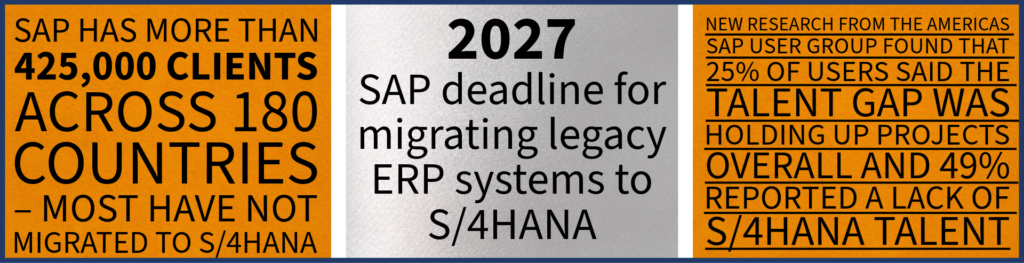
The SAP talent gap has come to the forefront in industry conversations around digital transformation and mandatory upgrades forecasted for the next several years. This recent Forbes article shines a spotlight on the growing talent gap in the SAP ecosystem, particularly in relation to the migration of existing ERP systems to the S/4HANA platform. SAP has set a 2027 deadline for migrating legacy ERP systems to S/4HANA–and most of SAP’s 425,000 clients worldwide have not started their migrations yet. 

While SAP S/4HANA can be used both on premise and in the cloud, the benefits of utilizing cloud technology are continually growing, convincing more and more organizations to make its adoption a priority. Organizations that wait too long to make the transition to the cloud may face difficulties due to outdated infrastructure. For an increasing number of organizations, it just makes sense when migrating to S/4HANA to simultaneously manage a move to the cloud. 

With just 3 years remaining until the SAP deadline, it’s clear that there will be a surge in migration projects, leading to an unprecedented demand for qualified talent and a growing concern over the SAP talent gap. Many organizations will face challenges when recruiting top talent for their own teams and in finding partners with experienced consultants who are available.

Working with experienced SAP consultants is crucial for any organization looking to maximize the potential of SAP software and to reduce risk when executing SAP projects. SAP is a complex and constantly evolving platform; working with consultants who bring varied and robust experience to the table is essential to ensure successful implementation and ongoing support of the system. 

Statistics about SAP talent gap concerns for 2027

In the early 2000s, the push to offshore SAP project delivery work exposed challenges when working with less experienced resources. Many projects were delivered behind schedule, incurred cost overruns, and resulted in functional and technical issues post-delivery. It was not unusual to have to invest significant capital to re-implement and clean up the issues. This experience led to the onshoring of many roles and to changes in how companies engage offshore resources. Moreover, it highlighted the importance of finding experienced SAP consultants and employees with SAP skills.

Senior SAP consultants provide the following benefits: in-depth knowledge and expertise, business acumen and familiarity with industry-specific processes, the ability to handle different SAP modules and integrations, an understanding of system upgrades and changes, efficient problem-solving skills, deep industry contacts and network, exposure to different project types and sizes, and an understanding of best practices. Those advanced skills lead to faster deployment and implementation, cost and time savings, and overall lower project risk.

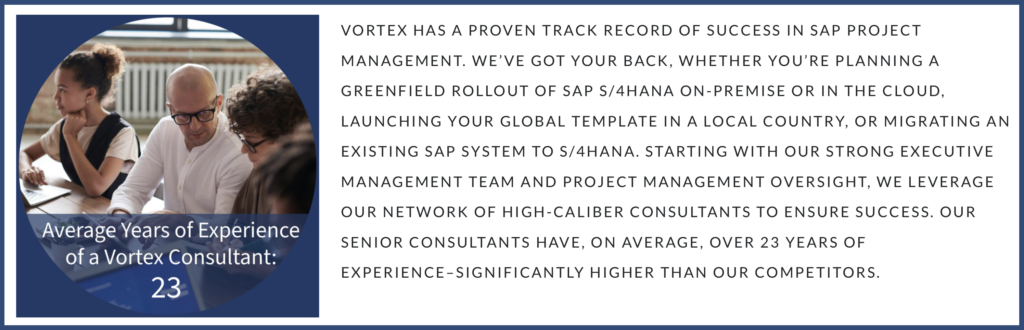
Vortex SAP consultants have 23 years of experience

The number of years of SAP experience is just one part of the equation when it comes to delivering a high-quality solution. At Vortex it is as much about understanding your corporate dynamic as knowing the SAP system. We take pride in forming true partnerships and working with our clients to find the best teams for their needs.     

In summary, it is expected to become more and more difficult to find the right resources given the growing SAP talent gap and the surge in demand to migrate to the cloud. Experienced consultants bring a wealth of knowledge and expertise, helping organizations to streamline processes, increase efficiency, and achieve their business goals with SAP. In this competitive business landscape, partnering with experienced SAP consultants can give businesses a competitive edge and ensure they are making the most of their SAP investment. At Vortex, we are confident that we bring the best teams in the industry to help our clients be successful. Send us an email to get a conversation started with a member of our senior leadership team today. 

SAP GRC: Digital Transformation Series, Part III

Today we continue our blog series on digital transformation. (For an overview on the topic, be sure to check out the first post in the series.) In our most recent post, we walked through 2 of 4 key areas to consider when it comes to digital transformation: Network security and SAP capabilities. Now, let’s take a look at the remaining key areas: Governance, risk management, and compliance–collectively known as GRC–and physical security. 

Consider these 3 main components to GRC: SAP Security, SAP Early Watch (pattern recognition), and Audit. Another way to think about GRC is establishing logical boundaries around roles and responsibilities and each employee’s related system access. In other words, no single person can complete all steps in the process. Here’s an example: If you cut the purchase order, you cannot be the one who approves the payment.

GRC can be difficult to design, implement, SAP GRC Best Practices for Business Securityand maintain successfully. It requires someone–or a team–with experience. You need to ensure that the right people have the right access to be able to do their jobs. At the same time, it is vital that the “slice of the pie” each employee sees is necessary to their role, defined, and secured. Also, this is not a “one and done” scenario. As the business evolves and changes, so do the roles and the unique access that each of the roles has within the organization. Strategic role design and maintenance is an ongoing process which is critical to the security of your organization.

Uniquely, the concern around establishing best practices in GRC is not about “getting hacked,” as it is for many aspects of digital business management. The focus is on limiting scenarios where someone may see a vulnerability and use it to defraud you. Controlling employee access is critical to limit opportunities for fraudulent behavior– but that access control is not limited to only employees.

In today’s interconnected environment, your vendors, suppliers, and customers may all have access points into your system. These access points all need security roles assigned to them to limit the view to only the appropriate and relevant information for the actor’s role. As an example, an external actor could see proprietary information and sell it to a competitor. Each partner or vendor should only see what is most relevant to and required for their specific role in the larger process.

Within your organization’s SAP framework, BPML–Business Process Mapping List–establishes employee and vendor access. GRC creates profiles in such a way that it encircles all relevant functionality before linking that role to a person. The truth of the matter is that many companies give people way too much access by accident!

GRC SAP Digital and Physical SecurityStandard SAP GRC risk detection and auditing settings compile reports and grant access to internal and external audits. This allows pattern recognition functionality to detect where key elements of your security infrastructure may have changed unexpectedly or where other gaps in the system may exist.

That brings us to Number 4: physical security. Identification procedures fall into this category–being sure that someone cannot get in, pretending to be someone they are not. Along those lines, when a consultant’s contract ends, it’s crucial to lock out their access immediately so that they can no longer access the premises, or the sensitive systems inside the premises. Whether you are building from the ground up, undergoing an expansion, or moving to a “new to you” space, make physical security a part of the discussion upfront.

As explored through our 3-part series, digital transformation and security is a broad-reaching topic that weaves into all aspects of your business. A successful digital ERP implementation or upgrade is based on a holistic view of security structure including external partners, project teams, and internal resources. Invest in bringing together these moving pieces to ensure a secure digital and physical environment for your organization’s assets. If you have questions about digital upgrades in SAP and Oracle, want to talk about staffing support options, or even need to fill a role immediately, be sure to contact us today. We look forward to helping you optimize your business operations as the digital world continues to grow and evolve.

Network Security & SAP Capabilities: Digital Transformation Series, Part II

Welcome to the second post in our blog series on digital transformation. As mentioned in our series kickoff, digital transformation security can be divided into four key areas: network security, SAP capabilities, SAP GRC (roles and access), and physical security. Let’s dive right into what those categories include, beginning with network security.

If you were to bring up the topic of technological security with a group of colleagues, chances are it’s network security that would first come up in discussion. Intrusion and phishing are a few of the main areas that fall into this category. In the case of intrusion, we’re talking about the detection of network entry without proper authorization. And, unfortunately, we’ve all seen phishing in action–fraudulent messages that seek to obtain personal, valuable information, and designed to look as though they were from a reputable organization. In order to maintain a truly secure system, all access points into your network, such as VPNs, need to be secured. The Vortex team is very aware of these threats and makes network security an integral part of every project, whether that’s including our own security experts in a full staffing scenario or collaborating with your on-staff security team during an SAP setup or upgrade.
This brings us to the second key area of digital security–SAP capabilities, our sweet spot. A core feature of SAP is that it helps to establish baseline security patterns, then detects when there are variations from those base guidelines. SAP is loaded with inherent process-based security capabilities that work toward detecting and preventing fraud and architecture issues:

  • Optical Scanning Tools, used in tandem with AI for managing and securing invoicing practices
  • Dispute Management tools for detecting irregularities in disputes or payments
  • Quality Management and audits for dealing with claims that there is an issue with your product quality
  • Accounts Receivable and Incoming Payments tools for analyzing who you owe and who owes you
  • Tools for detecting Internal Issues, such as identifying “bad apples” who may be trying to defraud the company
  • Tools for detecting Money Routing Irregularities by visualizing patterns where company money is moving

Machines and systems can recognize patterns in a way that humans cannot. Humans have the ingenuity, once these critical pieces of information are identified, to see things from different angles and make sense of situational information based on experience and expertise. It’s the experience of our senior leadership team and vast network of consultants that allows Vortex to recognize capabilities and apply them in unique ways for the benefit of our clients.

Network security and SAP capabilities are 2 of the 4 critical areas SAP Cloud symbol for network securitycomprising your holistic security architecture, and when discussing these, there’s another topic that cannot be excluded from the conversation–understanding security of cloud vs. on-premise. Simply said, the more you go on-premise with your SAP investment, the more SAP performance ability you give up. The powerful SAP cloud platform has stronger capabilities and is a sound, secure choice for your business in the long term.


What questions do you have about network security for SAP? Drop us a line or reach out on social media: LinkedIn and Twitter. Tune in for the next in our series on digital transformation security, where we’ll discuss GRC and physical security, coming soon here on the Vortex Consulting blog. 

Digital Transformation Security Goes Beyond Network Security

Digital transformation is a hot topic these days–but in reality it’s not a new one. Professionals in the ERP technology space have been moving businesses from old technology platforms to cutting edge software for over 30 years. Here at Vortex Consulting, we’ve been in business for 25 years, working in digital transformation–as seen in products like Oracle Cloud and SAP S/4HANA. Continue reading this first blog post in our new series and follow along for others in the upcoming months.

So why has research and development surrounding digital transformation been deemed so critical for over 3 decades? A key reason: efficiency. Digitizing workflow, storage, and processes in general means eliminating time-consuming, repetitive, inefficient tasks. It brings meaningful and successful automation to standard business processes, all while integrating data efficiently. As an example, let’s look at the process of invoicing. Long gone are the days of needing to manually scan an invoice, organize paper files, collect and match up payments, etc. All of this can be done digitally–it’s streamlined, takes less time and energy, and frees up employees to do more valuable work. Product orders are even transferred to third party logistics providers who automatically determine the most efficient delivery routes, can combine loads, and automatically select the lowest cost delivery options. 

Business owner with SAP compares low cost delivery options

There are newer technologies coming into play that add to the discussion of what is possible in digital transformation. The Internet of things (IoT), artificial intelligence (AI), data lakes, and improved pattern detection capabilities are each transformative in their own right. At the time of publishing this post, discussions about AI are dominating social spaces as its uses are tested in education, healthcare, information management, and beyond. 

Female business owner monitors SAP digital transformation

As application specialists, Vortex works in the realm of these digital technologies on every project. The SAP platform is at the core of the system, with SAP and third party satellites communicating as a network, enabling automation and digital flows of information–all of which must be secured. (Our work with Oracle-based clients functions in a similar way.) Adding to the complexity of the situation, there are always evolving technologies which require the integration of handheld devices, sensors, and portals that extend the network and must be integrated into SAP. With the introduction of more middleware tools to the SAP setup, those assets must be secured as well.

When it comes to digital transformation security, we’ve learned there are really 4 buckets: network security, SAP capabilities, SAP GRC (roles and access), and physical security. Throughout this blog post series, we’ll take a deep dive into each of those key areas. If you have questions you’d like us to address, reach out on Twitter or send an email to let us know. Watch for the next in our digital transformation security series soon.